
Scent Training for a DTC Brand Team: A Checklist Before You Book
A direct-to-consumer brand usually reaches scent training through frustration: too many sample rounds, feedback that changes between meetings, and a founder who cannot tell whether a supplier is proposing something good or something convenient. Training helps with all three, but only if it is bought to fix a named decision. The checklist below is what to settle before booking: who attends, what they will be assessed on, what materials they will smell, and how the skill stays in the business after the course ends.
Key takeaways
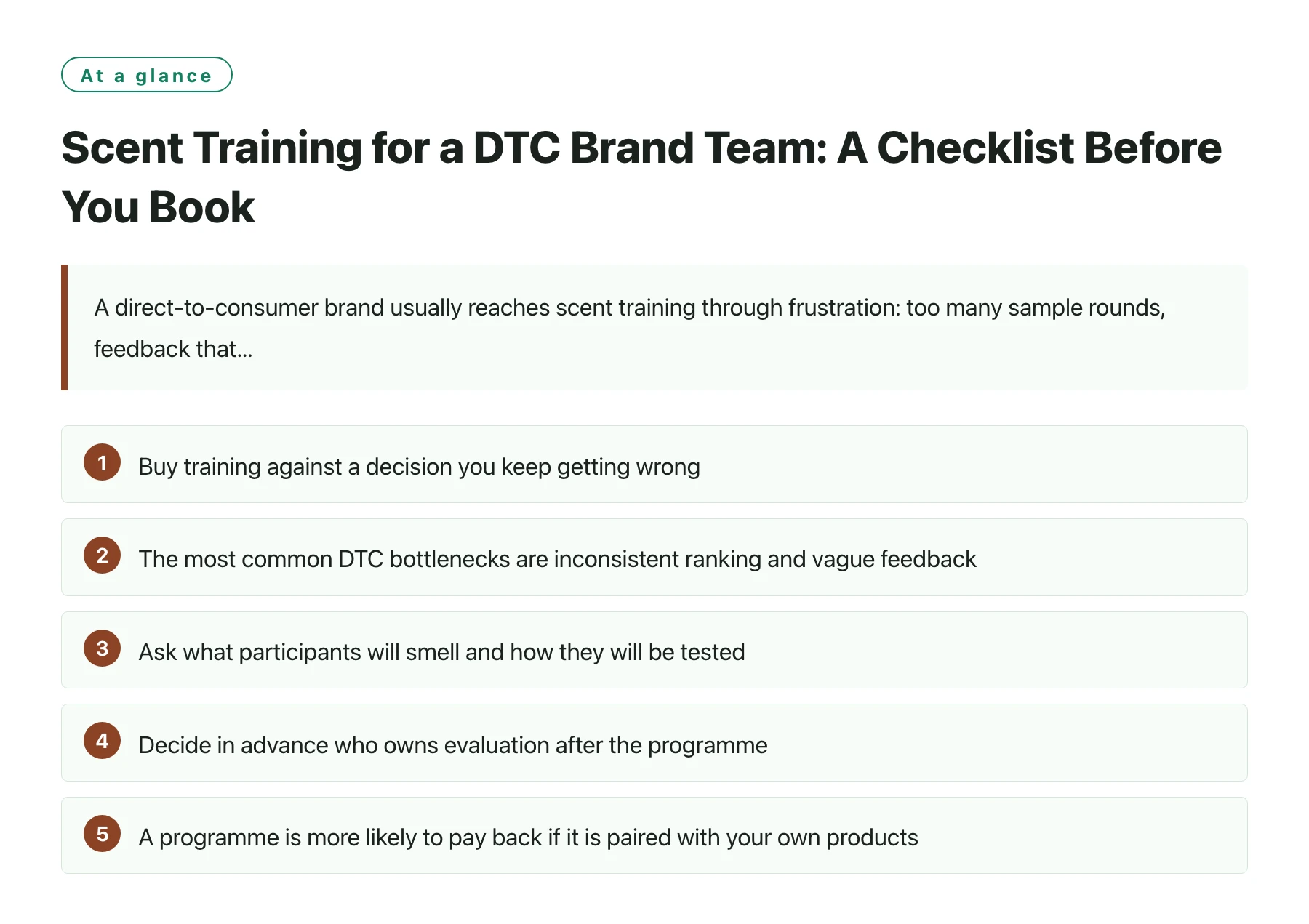
- Buy training against a decision you keep getting wrong, not against a general wish to understand fragrance better.
- The most common DTC bottlenecks are inconsistent ranking and vague feedback, both of which a short, well-assessed programme can improve more than a long, prestigious one.
- Ask what participants will smell and how they will be tested; a course without assessment produces confidence rather than capability.
- Decide in advance who owns evaluation after the programme, because a skill held by one person who leaves is a cost rather than an asset.
- A programme is more likely to pay back if it is paired with your own products, so the vocabulary learned attaches to decisions the team already makes.
Fragrance training is sold in several ways to young brands. There are short courses for enthusiasts, professional programmes for people entering the industry, masterclasses for specialists, and in-house sessions run by manufacturers. Prices vary widely and so does the content, but the marketing language does not, which is why buyers end up comparing brochures rather than outcomes.
The direct-to-consumer context narrows the field. A DTC brand typically has a small team, a fast iteration cycle and no in-house perfumer. Its recurring problem is not composing a scent; it is judging one, describing it consistently, and deciding which of three directions to take into production. Those are evaluation skills, and they are teachable in a shorter time than composition.
The other thing a DTC brand needs from training is confidence in the supply chain. A team that understands materials, dosage and base can tell whether a supplier's explanation is plausible, which changes the tone of the entire relationship. Industry bodies publish introductory material on fragrance and on how scents are evaluated, and it is a useful free starting point before paying for anything [1].
The booking checklist
| Item to settle | What good looks like | Warning sign |
|---|---|---|
| The decision being fixed | One sentence naming the recurring mistake, such as the team approving scents in a bottle that fail in a lotion | A vague ambition to understand fragrance better |
| Who attends | Everyone who gives scent feedback, including the founder and whoever writes the product brief | Sending one junior person so the founder can stay at their desk |
| What is assessed | A before-and-after test, or a project marked against a reference | No assessment, no feedback, a certificate on the last afternoon |
| The material set | Broad enough to cover the families the brand sells, and smelled more than once | A single session with a dozen blotters and no repetition |
| The teaching arrangement | Trainers who still work with materials and can explain a formula, not only a trend | Slides, anecdotes and a supplier pitch in the second half |
| Follow-up | A refresher, a project or a material kit to keep practising | Contact ends when the invoice is paid |
| Ownership after the course | A named person responsible for evaluation, with a documented vocabulary | Knowledge held informally by whoever attended |
Working through the table usually changes the purchase. A team that realises four people give feedback will stop considering a course designed for one specialist, and a team that cannot name the mistake it is trying to fix will often spend the budget on a material kit and a monthly tasting session instead, which is cheaper and, for them, better. Teams that want to see how a supplier frames the development work their training would support can Find out more before deciding which provider to approach.
What training does not fix
Training improves judgement. It does not replace testing, and a DTC brand that confuses the two will still launch a product that behaves badly in a candle or a body mist. Compatibility and stability work is a process with methods and reports, not an opinion that can be trained into a team.
It also does not substitute for a brief. Teams sometimes buy a course hoping it will clarify direction, when what was missing was a decision about price, format and audience. A perfumer can work from a disciplined brief; no amount of internal vocabulary helps if the brief says modern and premium and nothing else.
Finally, training does not make a supplier trustworthy. It makes a supplier easier to question, which is different and more useful. A team that can ask why a dosage was changed can decide whether the answer is technical or commercial, and that is the practical return on the fee.
Pairing the course with a live project
The cheapest way to make training stick is to run it against a project that is already open. If a development round is starting, ask whether the programme can use your own brief and your own candidate directions as teaching material. Participants then leave with both vocabulary and a decision about their actual product, which converts a training cost into development work.
A manufacturer that runs training alongside development can usually arrange this, because the same people write the formulas and run the sessions. Programmes described as professional scent training are the ones most likely to be structured this way, and it costs nothing to ask before booking.
Choosing the supplier you will learn from
There is a mild conflict in learning from a company that also wants your production business. It is not a reason to refuse, but it is a reason to keep the teaching material generic enough to travel. If everything you learn is a house convention, you will struggle to evaluate a second supplier, and evaluating a second supplier is exactly what a DTC brand should be able to do.
The practical compromise is to treat supplier-run training as project preparation and independent training as capability building, and to buy them in that order. Many brands start with a course, discover they need a project to apply it to, and then pay again for something they could have combined. Reading up on how to judge how to choose a perfume factory before committing to a training provider is a small step that prevents that.
If the budget allows one purchase this quarter, and the team's real problem is inconsistent feedback rather than a lack of knowledge, buy a material kit and a reference standard before buying a course. Agree on ten words, smell the same five materials every month, and score your own products against them. That habit, not the certificate, is what reduces sample rounds. When the team is ready for structured teaching, look for a custom fragrance development partner that can run it against a live brief rather than a generic syllabus.
Sources
- The Fragrance Foundation —— A non-profit organisation for the fragrance industry, running perfumery education programmes and industry recognition.
Frequently asked questions
How long should a first scent training course be for a small DTC team?
Long enough to smell a range of materials more than once and to be assessed. For most small teams that means a structured programme measured in days rather than a single afternoon. A one-day introduction is useful for shared vocabulary but rarely produces people who can rank directions consistently a month later.
Should the founder attend?
If the founder gives scent feedback, yes. The most common DTC failure is a team that can describe a scent while the person with final approval cannot, which puts the team's vocabulary at the mercy of one opinion. Attendance also signals that evaluation is a real part of the job rather than an optional interest.
Is it worth paying for training when a manufacturer offers sessions free?
Free sessions are worth taking and are usually narrow. They teach a specific house's materials, formats and methods, which is useful for a live project. Paid independent programmes tend to be broader and more portable. Many brands get value from both, but they should not mistake the free session for capability building.
What is a reasonable outcome to expect from training?
Fewer sample rounds, faster agreement inside the team, and more specific briefs to suppliers. Those are the measurable returns. A certificate and a pleasant memory of the day are not evidence that anything changed, which is why the assessment question matters so much before booking.
Can a DTC brand build this capability entirely in-house?
Partly. A material kit, a written vocabulary and a monthly evaluation habit cost little and cover a great deal. What cannot easily be replicated internally is exposure to unfamiliar materials and assessment by someone experienced. Treat formal training as the way to widen the material set, not as the only route to competence.